
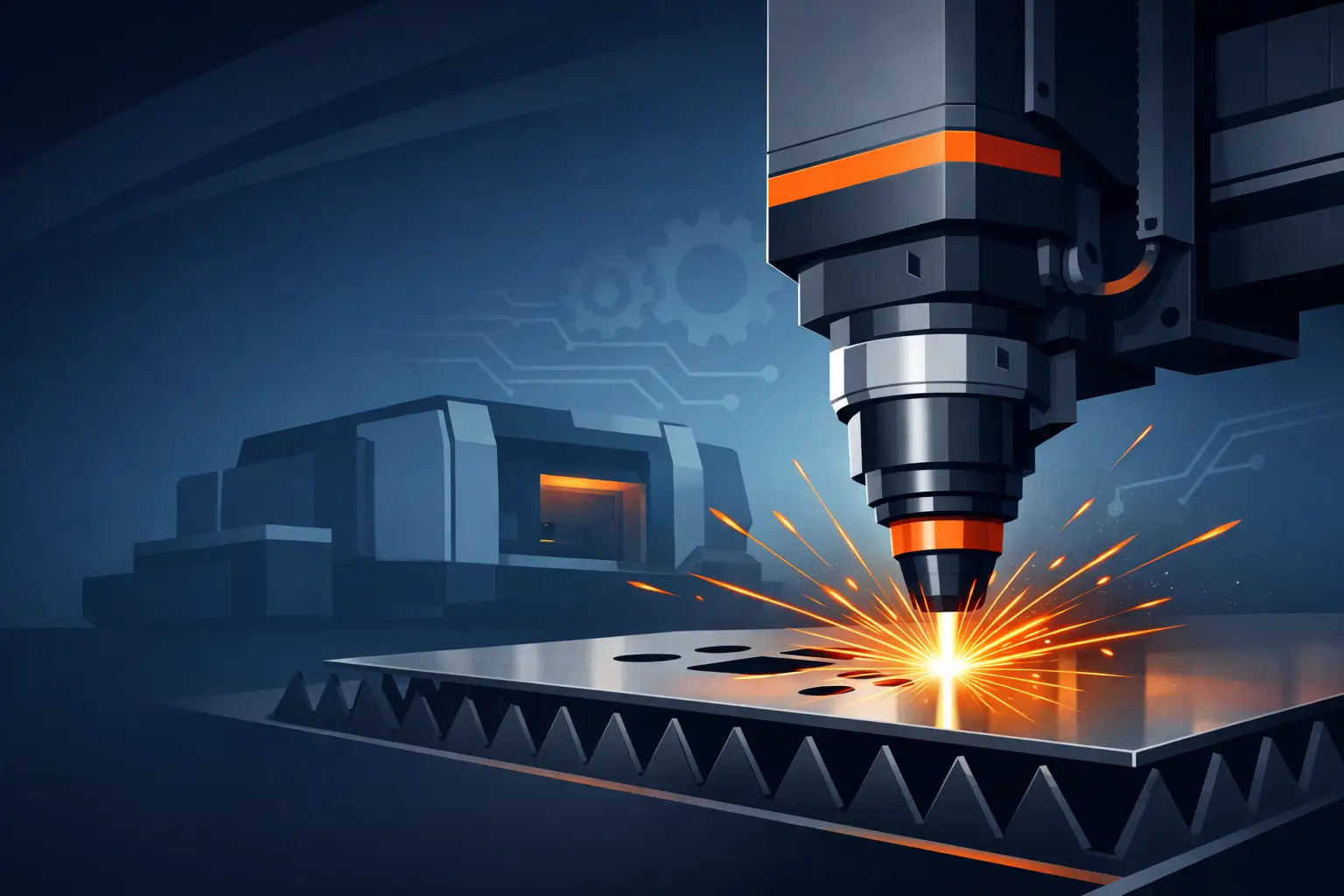
If you are comparing metal cutting equipment for a production shop, the question usually comes up fast: what is cnc fiber laser cutting machine technology, and why has it become the standard choice for so many fabrication businesses? The short answer is that it is a computer-controlled machine that uses a fiber-generated laser beam to cut sheet metal and plate with high speed, tight accuracy, and clean edge quality. The longer answer matters more, because machine design, power level, motion quality, and support all affect how well that promise holds up in a real workshop.
What Is CNC Fiber Laser Cutting Machine Technology?
A CNC fiber laser cutting machine is a metal cutting system that combines two core technologies. The CNC side controls movement, position, cutting paths, and repeatability. The fiber laser side generates a concentrated beam of light that melts or vaporizes material along a programmed path.
In practical terms, the machine reads a CAD-based file, moves the cutting head over the work area, and follows the programmed geometry with very high precision. Assist gas is used at the cut point to improve edge quality and help remove molten material. The result is a fast, accurate process that suits commercial production far better than manual cutting methods.
This is why fiber lasers are common in fabrication shops making brackets, enclosures, panels, signage, machine parts, ducting components, and custom production runs. For businesses that need repeatability and output, the CNC control is just as important as the laser source itself.
How a CNC Fiber Laser Cutting Machine Works
The cutting process starts with the laser source. In a fiber laser, the beam is generated through optical fiber technology rather than the mirror-based system commonly associated with older CO2 laser designs. That beam is then delivered through a fiber cable to the cutting head, where it is focused onto a very small point on the material surface.
At that focal point, energy density is extremely high. The metal heats rapidly and begins to melt. Depending on the material and setup, assist gas such as nitrogen or oxygen is directed through the nozzle to clear the cut and influence finish quality. The CNC system coordinates head movement, acceleration, cornering, and path optimization so the machine can cut complex shapes consistently.
Good machine performance depends on more than laser wattage. Frame rigidity, servo quality, linear guide accuracy, rack and pinion quality, height control, nesting software, and electrical layout all affect the final result. A powerful source on a poorly built frame will not deliver reliable production accuracy for long.
The Main Parts of the Machine
Most systems share the same major components. The laser source creates the beam. The cutting head focuses it and maintains proper stand-off height from the material. The CNC controller manages motion and cutting logic. Servo motors and drive systems move the gantry and head. The bed supports sheet material, and the extraction system helps manage fumes and dust.
You will also typically see a chiller, gas control system, and operator interface. On higher-demand production machines, those supporting systems are not minor details. They contribute directly to cut stability, uptime, and maintenance intervals.
What Materials Can It Cut?
Fiber laser cutting machines are primarily built for metal processing. They are widely used for mild steel, stainless steel, aluminum, brass, and copper, though actual cutting performance depends on laser power, head design, and machine setup.
Mild steel is usually where buyers see the most obvious speed and cost advantage. Stainless steel cuts cleanly and is common in fabrication, food equipment, and architectural work. Aluminum requires proper setup because reflectivity and heat behavior differ from steel. Brass and copper can also be processed on suitable systems, but they demand the right source capability and process control.
Thickness range is where expectations need to stay realistic. Thin sheet can be cut very quickly, often with excellent edge quality. As material gets thicker, cut speed drops and edge condition can vary depending on gas type, nozzle condition, pierce strategy, and machine tuning. That is why the best machine is not always the highest wattage on paper. It is the machine matched to the work you actually run every week.
Why Shops Choose Fiber Laser Cutting
The main reason is productivity. A fiber laser can process metal parts much faster than many traditional methods, especially on thin to medium gauge sheet. It also reduces secondary cleanup on many jobs because edges are cleaner and more consistent.
Accuracy is another major advantage. With a stable frame, quality motion system, and well-tuned controller, a CNC fiber laser cutting machine can repeat part geometry reliably across batch production. That matters for fabrication businesses supplying assembly-ready components, where variation creates downstream delays.
Operating efficiency also plays a part. Fiber laser systems are generally more energy-efficient than older CO2 designs, and they involve fewer optical maintenance demands. That does not mean they are maintenance-free, but it does mean the ownership experience is often better suited to busy commercial shops that need dependable uptime.
For businesses bringing cutting in-house, lead times can improve significantly. Instead of waiting on external processing, shops can control scheduling, prototype faster, and respond more quickly to customer changes. That flexibility often becomes just as valuable as the cutting speed itself.
Where a Fiber Laser Fits Best
Fiber laser cutting is a strong fit for metal fabrication environments with steady production demands. If your business processes sheet metal daily, runs repeat parts, or needs fast turnaround on custom work, the technology usually makes sense. It is especially effective where precision, nesting efficiency, and clean finished parts are priorities.
It is also a good fit for shops that want to scale output without adding labor-heavy manual cutting processes. A properly specified machine can increase throughput while improving consistency between operators and between shifts.
That said, application matters. If your work is mostly heavy plate at lower volumes, another process may still play an important role alongside laser cutting. If your shop cuts mostly non-metal materials, then a different laser category or another CNC platform may be more appropriate. This is one of those areas where buying based on workload beats buying based on trends.
The Trade-Offs Buyers Should Understand
Fiber lasers offer strong production advantages, but they are not one-size-fits-all machines. Initial investment can be substantial, especially when moving into higher power systems with larger bed sizes, exchange tables, and automation options. Shops need to look beyond the machine price and consider installation, extraction, gas supply, training, service access, and material flow.
Power level is another area where buyers can overspend or underspec. More power can improve thick-material performance and cycle times, but it also increases machine cost. If most of your work is thin stainless and mild steel, a balanced system may offer better return than a machine selected only for occasional maximum thickness jobs.
Support should also be part of the buying decision. A laser is a production asset, not a commodity purchase. When a shop depends on output every day, responsive technical backup, clear installation guidance, and parts support become operational requirements. This is where experienced machinery suppliers separate themselves from box-movers.
What to Look for When Choosing a CNC Fiber Laser Cutting Machine
Start with your workload. Material type, common thickness, sheet size, production volume, and expected tolerances should guide the machine specification. A buyer cutting thin gauge sheet at high volume has different needs from a job shop handling mixed materials and short-run custom work.
Then look closely at machine build quality. Rigid frames, stable gantry design, accurate motion components, and clean electrical engineering matter because they affect real-world cutting performance over time. A machine might look competitive in a brochure, but production reliability depends on what sits underneath the cover panels.
Software and control usability also deserve attention. Operators need efficient nesting, clear job setup, and dependable control logic. The easier the system is to run correctly, the faster a shop gets value from it. Training and after-sales support are part of that equation.
It is also worth asking how the supplier handles installation, service, and troubleshooting. For many shops, especially those adding their first laser system, practical technical support is a deciding factor. MadBytes approaches this from a workshop-first position, focusing on machine durability, customization, and direct support that helps customers keep production moving.
What Is CNC Fiber Laser Cutting Machine Value in Real Production?
The value is not just that it cuts metal with a laser. It is that the right machine can turn design files into accurate parts quickly, repeatedly, and with less wasted time between steps. In a production environment, that means faster quoting turnaround, tighter scheduling control, and more confidence when jobs need to move.
For some businesses, the biggest gain is throughput. For others, it is cleaner part quality or the ability to bring outsourced cutting back in-house. The right answer depends on your mix of materials, part complexity, and delivery pressure. That is why machine selection should always start with the jobs you run, not just the specs you admire.
If you are evaluating a CNC fiber laser cutting machine, look for the setup that fits your production reality today and still gives you room to grow tomorrow. The best machine is the one that keeps cutting accurately when the workload is real.