
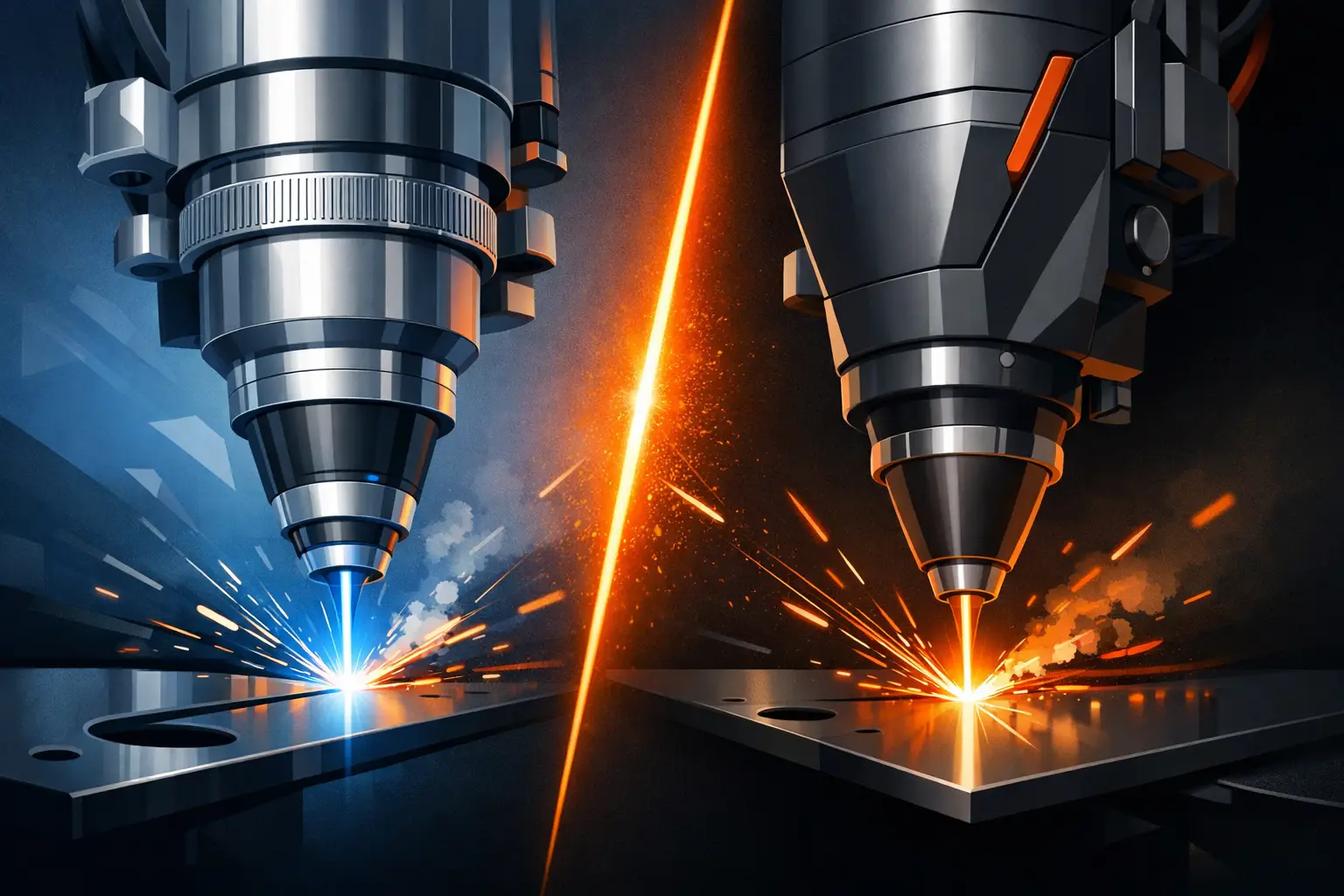
If you are weighing co2 laser vs fiber laser, the wrong choice usually shows up fast on the shop floor. You either end up with a machine that is excellent at materials you rarely process, or one that struggles with the jobs that actually pay the bills. For production environments, this is less about theory and more about throughput, edge quality, maintenance, and whether the machine matches your day-to-day work.
The short version is simple. CO2 lasers are typically the stronger fit for non-metal materials like wood, acrylic, plastics, leather, fabric, and many signage applications. Fiber lasers are built for metal processing, with faster cutting speeds on sheet metal, strong marking performance, and lower routine maintenance in many production settings. But there are trade-offs, and that is where buying decisions get expensive.
CO2 laser vs fiber laser: the core difference
A CO2 laser generates its beam from a gas mixture, while a fiber laser generates its beam through a solid-state source and delivers it through optical fiber. That technical difference changes how each machine interacts with different materials.
In practical terms, a CO2 system is usually chosen for versatility across non-metals and for the finish it can produce on materials such as acrylic, MDF, plywood, and other signage or display substrates. A fiber laser is usually chosen for metal fabrication because the beam is better suited to cutting reflective and conductive metals with speed and consistency.
That distinction matters more than headline wattage. Buyers often compare power ratings first, but material type, cut quality, and production volume usually have a bigger effect on return from the machine.
What each laser does best
Where CO2 lasers make sense
CO2 lasers remain a strong option for shops producing signage, display work, joinery components, packaging prototypes, decorative panels, and custom fabricated parts in non-metal materials. If your work regularly includes acrylic lettering, engraved timber panels, MDF templates, foam, or similar substrates, a CO2 machine is often the more natural fit.
It also gives you flexibility across a wider range of organic materials. For shops that need one machine to cover varied non-metal jobs rather than high-volume metal cutting, that flexibility is valuable. A cabinetmaker, sign shop, or custom manufacturer may get more use from a CO2 platform simply because it matches the material mix coming through the door.
Where fiber lasers make sense
Fiber lasers are the preferred choice for metal shops, fabrication businesses, and manufacturers processing mild steel, stainless steel, aluminum, brass, and similar metals. They are especially effective when speed, repeatability, and low downtime are priorities.
For sheet metal work, a fiber machine is typically the production tool. It cuts faster, handles thin to medium-gauge metals efficiently, and supports a more streamlined workflow for industrial metal fabrication. If your jobs are mostly brackets, panels, enclosures, cabinets, sheet components, or production parts, fiber is usually the right direction.
Material compatibility is the real decision point
Most buying mistakes happen because people ask which laser is better in general. That is not the right question. The useful question is which laser is better for your material mix.
If your core output is wood, acrylic, plastics, leather, and signage substrates, CO2 is usually the better match. If your core output is metal, fiber is the stronger machine. If your business handles both in serious volume, you may be looking at two dedicated systems rather than one compromise.
This is where a proper application review matters. A machine that looks cheaper upfront can become expensive if it slows production, limits job intake, or forces secondary finishing because edge quality is not where it needs to be.
CO2 laser vs fiber laser for speed and productivity
In metal cutting, fiber lasers generally lead on speed. That advantage becomes more obvious in production environments where cycle time matters across hundreds or thousands of parts. Faster cutting is not just about finishing jobs sooner. It affects labor efficiency, quoting accuracy, and how much work your shop can take on without adding shifts.
CO2 systems are not slow by default, but they are usually not the first choice when the work is primarily metal. Their value shows up when processing non-metal materials where cut quality and material compatibility are more important than direct speed comparisons against fiber.
For many businesses, productivity is also about setup and consistency. A machine that starts cleanly, repeats accurately, and requires less intervention during a run often delivers more value than one with impressive specs on paper.
Edge quality and finished result
Cut quality depends on material, thickness, machine build quality, optics, control system, and setup, not just laser type. Still, there are predictable patterns.
CO2 lasers are widely valued for clean results on acrylic and many non-metals, which is one reason they remain popular in signage and display production. Fiber lasers deliver the cut characteristics metal fabricators expect, especially when paired with a rigid machine platform, accurate motion system, and properly configured assist gas setup.
If your finished parts go straight to welding, folding, assembly, or customer delivery, edge condition matters. It affects downstream time. A machine should not just cut the part. It should fit your process after the cut.
Operating costs and maintenance
This is where buyers need a realistic view. Fiber lasers often have an advantage in routine maintenance because the laser source architecture is generally simpler from a service standpoint than older gas-based systems. That can mean fewer consumable-related interruptions and less maintenance pressure over time.
CO2 machines can still be very productive and dependable, but they usually require more attention to optics, alignment, and related service items depending on the design and workload. That does not make them a poor choice. It means the machine should be selected with a clear understanding of the operating environment and maintenance expectations.
For a commercial shop, downtime matters as much as purchase price. Good support, parts access, and a machine built with clean electrical engineering and stable components can make a bigger difference than small savings at the point of sale.
Purchase price vs long-term value
A lot of buyers focus too hard on entry price. That is understandable, but machinery should be evaluated over years of production, not just the invoice date.
A CO2 machine may be the better investment if it opens profitable work in signage, woodworking, custom fabrication, and engraving on non-metals. A fiber laser may deliver stronger long-term value if your business depends on metal throughput, repeatability, and reduced maintenance burden. The better machine is the one that supports your quoting, your production schedule, and your customer deadlines.
This is also where machine construction matters. Frame rigidity, motion accuracy, source quality, bed design, fume management integration, and service support all shape long-term performance. Two machines with similar labels can behave very differently in a working shop.
Who should choose CO2 and who should choose fiber
A CO2 laser is usually the right fit for sign makers, display manufacturers, cabinet shops, schools with non-metal fabrication programs, and custom businesses cutting mixed non-metal materials. It works well when job variety is high and material types are broad.
A fiber laser is usually the right fit for metal fabrication shops, engineering workshops, sheet metal processors, enclosure manufacturers, and production businesses where metal cutting is central to the operation. It is built for output, repeatability, and commercial metal work.
If you are a growing shop trying to serve both markets, the honest answer may be that one machine will not cover both profitably. It is better to choose the machine that matches your main revenue stream than to buy a compromise system that only handles half your work well.
The machine matters as much as the laser type
The co2 laser vs fiber laser discussion is useful, but it should not stop at beam technology. Real performance depends on the complete machine. A rigid frame, stable gantry, accurate drive system, well-designed controls, and dependable after-sales support have a direct impact on cut consistency and uptime.
That is especially true for commercial workshops where lost production costs more than a spec sheet can show. A well-supported machine from a supplier that understands installation, setup, troubleshooting, and long-term service is often the safer investment. MadBytes takes that workshop-first approach because production equipment has to perform under load, not just look competitive in a brochure.
So which one should you buy?
If your work is mostly wood, acrylic, plastics, and signage materials, start with CO2. If your work is mostly steel, stainless, aluminum, and fabricated metal parts, start with fiber. If you are still undecided, review your last six months of jobs and see what actually generated revenue, not what you hope to take on later.
The right laser should fit the way your shop runs now, while giving you room to grow without creating bottlenecks. Buy for the work that keeps your machines busy, your team productive, and your delivery dates under control.