
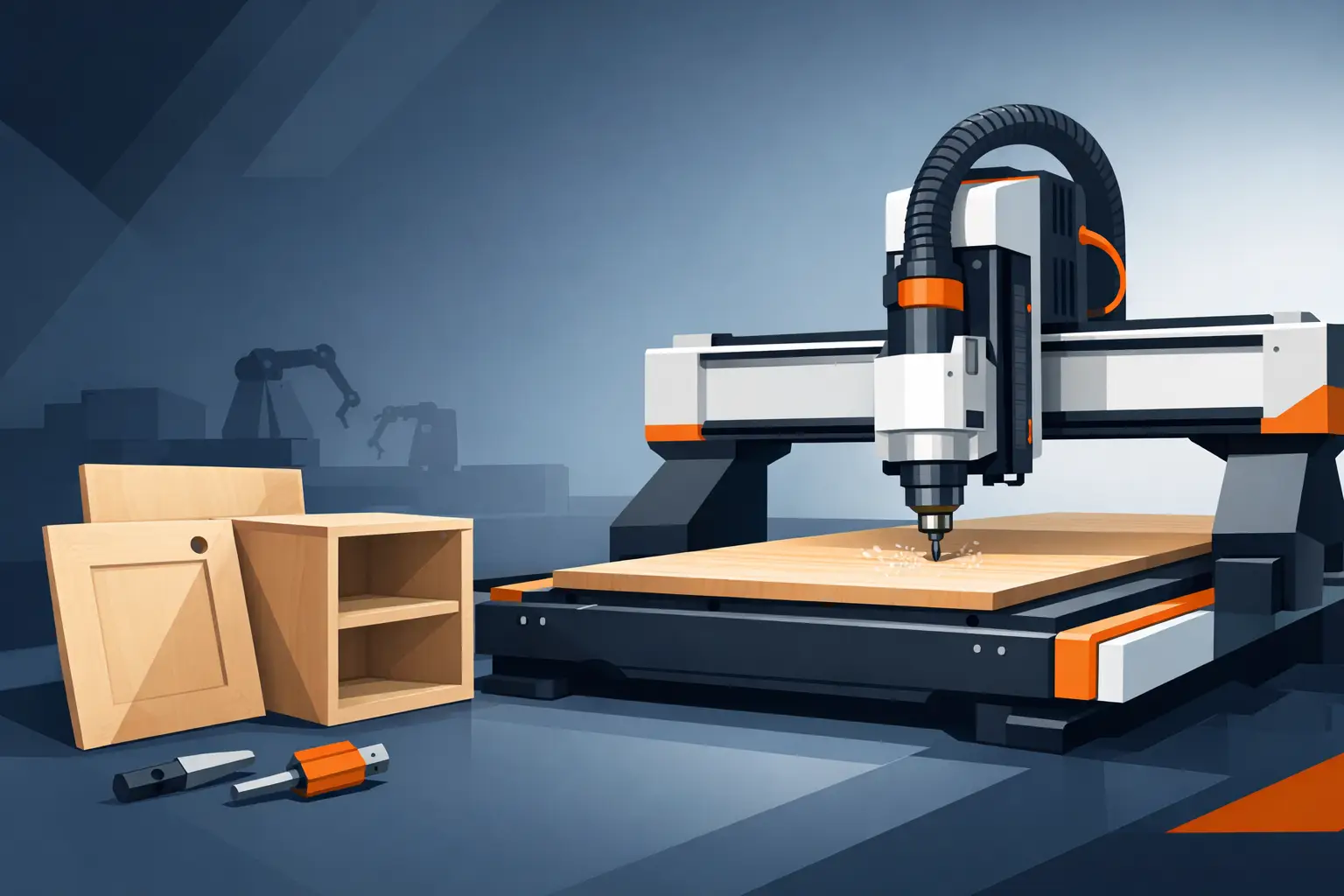
A cabinet shop usually feels the pressure first in the same place – lead times. One week it is nested sheet jobs stacking up. The next, it is hardware drilling, repeat parts, and labor hours disappearing into work that should already be standardized. A cnc router for cabinet making changes that equation, but only if the machine is matched to the way your shop actually builds.
That is where many buying decisions go wrong. Shops compare spindle power, price, or table size in isolation, then end up with a machine that looks good on paper but struggles under production loads. Cabinet work is not just about cutting panels. It is about repeatability, clean edge quality, dependable hold-down, drilling accuracy, and keeping throughput steady when deadlines tighten.
What a CNC router for cabinet making really needs to do
Cabinetmaking puts a different kind of demand on a router than occasional sign work or light general woodworking. You are not just shaping decorative parts. You are processing sheet material consistently, often all day, while holding tolerances across carcass panels, shelves, doors, backs, and machining for assembly.
For that reason, rigidity matters more than headline specs. A machine with a solid frame, stable gantry, and accurate motion system will hold quality over time far better than a lighter platform pushed to run beyond its comfort zone. In practical terms, that means cleaner dadoes, more consistent pocket depths, better edge finish, and fewer surprises when parts reach assembly.
Vacuum performance matters just as much. In nested cabinet production, poor sheet hold-down creates movement, and movement creates scrap. Even a small shift can affect fit-up, boring positions, and repeatability across a full run. If your workflow relies on cutting melamine, MDF, plywood, or particle board in volume, the hold-down system is not an accessory. It is part of the production result.
Tooling strategy also changes the conversation. Cabinet shops often need a mix of cutting, grooving, boring, and occasional engraving or label marking depending on workflow. That is why machine configuration should be viewed as a production system, not just a table with a spindle.
Table size, bed layout, and sheet handling
The right table size depends on what enters your shop every day, not what might be useful once a year. For many cabinet manufacturers, full-sheet processing is the baseline requirement. Machines in common production formats such as 1325 are often a practical starting point because they suit standard panel work and nested jobs without forcing awkward material handling.
Larger bed options can make sense when your operation processes oversized sheets, larger commercial joinery components, or multiple zones for improved throughput. But bigger is not automatically better. A larger machine takes more floor space, changes loading methods, and may require a different material flow around the workshop. If your team is manually loading and unloading all day, the machine footprint and access around it affect efficiency almost as much as the spindle itself.
Bed zoning is worth serious attention. A well-designed vacuum zone layout improves hold-down on smaller sheets and offcuts while reducing wasted suction. That can make a measurable difference in real cabinet production, especially if your job mix changes often.
Accuracy is not just a spec sheet number
When buyers ask about accuracy, they often want a single figure. In cabinet work, accuracy is more useful when understood as a combination of machine build quality, drive system performance, calibration stability, and electrical engineering.
A cnc router for cabinet making must repeat the same operation across a long production run without drift showing up in panel dimensions, hardware locations, or joint fit. That is why a rigid frame and dependable motion components matter so much. Rack quality, linear guides, servo or stepper tuning, spindle stability, and control system consistency all contribute to whether the first sheet and the fiftieth sheet match.
Electrical quality is often overlooked during comparison, but it has a direct effect on uptime. Cleanly integrated controls, properly organized electrical systems, and dependable components make troubleshooting easier and reduce the chance of nuisance faults interrupting production. For a cabinet shop, downtime is not a technical inconvenience. It is delayed installs, missed delivery dates, and labor standing still.
Manual tool changes or ATC?
This is one of the clearest it-depends decisions in cabinet production. A manually changed spindle can be the right fit for lower-volume shops, startups, or businesses with a narrower range of operations per sheet. If the work is mostly profile cutting and simple machining, a manual setup may keep capital cost lower while still delivering a strong production upgrade over hand-guided methods.
Once the workflow becomes more varied, an automatic tool changer starts to justify itself quickly. If your parts regularly move between compression tooling, drill operations, grooving, and detail work, ATC reduces interruptions and keeps cycle times more predictable. It also lowers the chance of operator inconsistency during changeovers.
For growing cabinet businesses, ATC is often less about speed in one moment and more about maintaining production rhythm across the full day. That matters when your machine is expected to carry repeat jobs, custom work, and urgent add-ons without constant manual intervention.
Drilling, nesting, and edge quality
Most cabinet shops are not buying a router simply to cut outlines. They need reliable nesting performance and the ability to support downstream assembly. That means considering whether the machine will be used with drilling capability, whether software output matches your cabinet design workflow, and how edge finish affects secondary operations.
Poor edge finish on melamine or laminated board creates more than an appearance issue. It adds cleanup, slows assembly, and can reduce confidence in the final product. Spindle quality, machine rigidity, feed strategy, and tooling all play a part here. A stronger machine platform gives you a better chance of maintaining cut quality at productive speeds rather than slowing everything down to protect the finish.
If your jobs include hardware preparation or repeated boring patterns, make sure the machine specification supports that production need rather than assuming you will add workarounds later. Workarounds have a way of becoming permanent inefficiencies.
Support matters after the machine lands
A machine can be well built and still fail the shop if support is weak. This is especially true for businesses moving into CNC for the first time, but experienced buyers care just as much because they know how expensive downtime becomes.
Installation guidance, training support, responsive technical help, and access to real engineers make a major difference in day-to-day ownership. The best supplier relationship is practical. You want clear setup help, sensible advice on machine configuration, and someone who can assist when production is on the line.
That is one reason many professional buyers look beyond generic commodity imports. They want a machine built for production, but they also want backup that continues after delivery. Companies such as MadBytes focus heavily on that workshop-first approach because machine reliability is only half the story. Ongoing support is what protects output over the life of the equipment.
Buying for the shop you are running – and the one you are building
A small custom cabinet shop and a larger production facility can both need a cnc router for cabinet making, but they may need very different configurations. One may prioritize flexibility and manageable investment. The other may be chasing throughput, labor efficiency, and reduced setup time across repeated jobs.
That is why the best buying question is not What is the biggest machine I can afford? It is What machine will run my current work reliably and still support the next stage of growth?
If your backlog is driven by sheet processing, a solid full-sheet platform with dependable vacuum and a well-matched spindle may be the right answer. If your production already involves varied toolpaths, drilled features, and high repeat volume, stepping into an ATC-equipped build may save more time than the purchase price difference suggests.
Custom configuration can also be the difference between a machine that fits and a machine that forces compromise. Work size, spindle selection, hold-down layout, control preference, and material mix all shape the right specification. A supplier that understands cabinet production will ask about those details early, not after the order is placed.
The right machine should feel less like a gamble and more like a capacity upgrade you can measure in cleaner output, steadier scheduling, and fewer production bottlenecks. When a router is engineered for real workshop demands, cabinetmaking becomes less about catching up and more about building with consistency.