
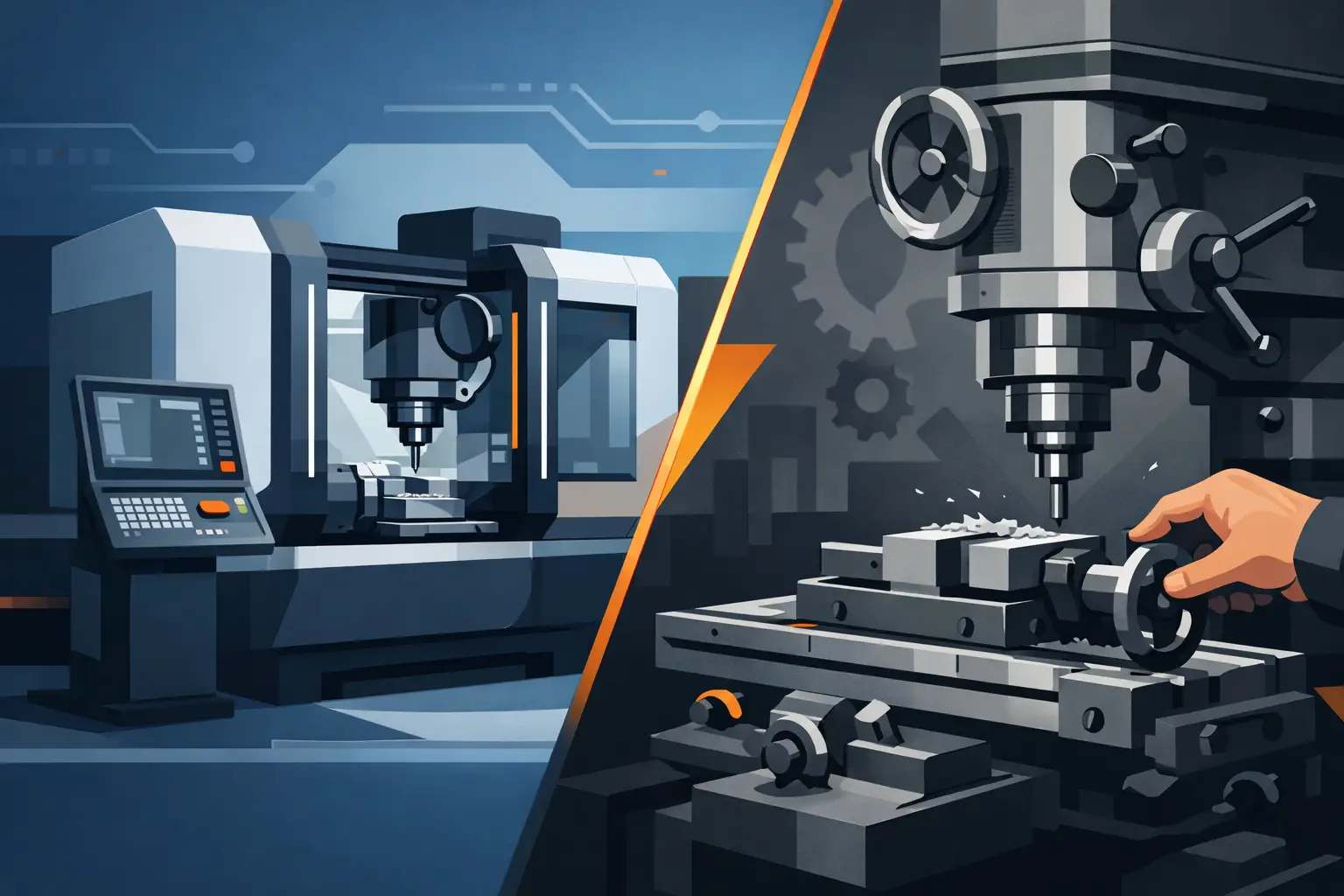
A machine that misses size by a fraction on one part might only waste one blank. Miss that same dimension across a batch of 200, and it becomes a production problem. That is where the difference between CNC and conventional machine setups stops being academic and starts affecting delivery times, labor costs, and shop reputation.
For workshop owners, cabinetmakers, fabricators, and production managers, the choice is not simply old versus new. It is a decision about repeatability, operator dependency, throughput, and how much control you want over every cycle. Both machine types still have a place in real manufacturing, but they solve different problems.
What is the difference between CNC and conventional machine setups?
At the simplest level, a conventional machine is operated directly by the machinist. Movement, feed, depth, and cutting path are controlled by handwheels, levers, and manual settings. A CNC machine uses computer numerical control to execute programmed movements automatically, usually through servo-driven axes and software-defined toolpaths.
That sounds straightforward, but the practical difference between CNC and conventional machine performance is much bigger than automation alone. CNC changes how work is prepared, how repeat jobs are handled, how errors are reduced, and how quickly a shop can scale from one-off work to regular production.
A conventional mill, lathe, or router depends heavily on operator skill at the machine. A CNC router or laser depends more on setup quality, programming accuracy, machine rigidity, and control system reliability. In other words, manual machines put more of the result in the operator’s hands. CNC puts more of the result into the process.
Accuracy and repeatability are not the same thing
One of the most common buying mistakes is treating accuracy and repeatability as if they mean the same thing. They do not.
A skilled machinist on a conventional machine can produce very accurate work, especially for simple operations or short runs. The challenge is maintaining that same result across multiple parts, multiple shifts, or multiple operators. Hand-fed machining introduces natural variation. Even in experienced shops, consistency can drift with fatigue, setup changes, or time pressure.
CNC equipment is built to reduce that variation. Once a program, datum, and tooling setup are proven, the machine can repeat the same motion over and over with far less operator influence. This matters in cabinetry, signage, sheet processing, and metal fabrication where parts need to match cleanly at assembly, not just look close enough on the bench.
That repeatability also becomes more important as part complexity increases. Straight cuts and simple bores are one thing. Nested panels, shaped components, detailed engraving, pocketing, and multi-step machining are another. That is where CNC starts to show a clear production advantage.
Speed depends on the job, not just the machine
People often assume CNC is always faster. In production, it usually is. For a one-off repair, quick trim, or simple manual cut, that is not always true.
Conventional machines can be efficient for very basic jobs because there is little programming overhead. If an experienced operator needs to make a minor adjustment, face one part, or perform a straightforward operation, manual control can be the faster route from setup to finish.
CNC becomes faster when the part count rises, the geometry becomes more involved, or multiple operations need to be completed in one workflow. A properly configured CNC router can process sheet material with consistent feed rates, clean path control, and reduced rework. A laser system can deliver precision cutting without the stop-start variation that comes with manual methods.
The real time savings come from process stability. CNC does not just cut cycle time. It cuts measuring time, repositioning time, marking-out time, and remake time. In a commercial shop, that difference adds up quickly.
Labor requirements shift from manual skill to process control
Another major difference between CNC and conventional machine operation is where the skill sits.
With conventional machinery, much of the result depends on the operator’s hand skill and judgment during the cut. Feed pressure, travel speed, cut depth, and alignment are actively managed in real time. That is why strong manual machinists remain valuable.
With CNC, the workload shifts upstream. More time goes into programming, fixturing, job setup, tooling selection, and verifying the process before production starts. The operator still matters, but the role becomes more about machine control, material handling, quality checks, and maintaining a stable workflow.
For business owners, this changes staffing decisions. A manual shop may rely on a small number of highly experienced people who carry a lot of production knowledge in their hands. A CNC-based shop can build more repeatable systems that are easier to train around, provided the machine, software, and support are solid.
That does not mean CNC eliminates skilled labor. It means the skill profile changes. Good CNC production still requires people who understand tooling, feeds, machine behavior, and how to hold tolerances under real load.
Cost is more than purchase price
Conventional machines usually come with a lower entry cost. For smaller operations or low-frequency use, that can make sense. If the work is simple, the batches are short, and labor capacity is already available, a manual machine may offer acceptable value.
But purchase price alone rarely tells the full story. CNC equipment often costs more upfront because it includes motion control systems, drives, software, electrical components, and a more advanced machine structure. In return, it can reduce labor per part, improve yield, support longer runs, and make quoting more predictable.
This is where buyers need to be realistic. A low-cost machine that struggles with rigidity, electrical quality, or support can become expensive very quickly. In production, downtime, inconsistency, and lost material are often more costly than the original machine price difference.
That is why machine build quality matters. A rigid frame, accurate motion system, clean electrical engineering, and dependable technical support are not luxury features. They directly affect whether a CNC machine performs like a production asset or a constant interruption.
Complex work strongly favors CNC
If the job involves repeating shapes, nested sheet layouts, contour cutting, drilling patterns, pocketing, engraving, or tool changes, CNC is generally the better fit. It handles geometry that would be slow, difficult, or inconsistent on conventional equipment.
This is especially relevant for cabinet shops, sign makers, and fabricators producing parts from wood, composites, plastics, aluminum, or mild steel depending on the machine type. A CNC router can move from custom panel work to production batches with the same control platform. An ATC-equipped setup can push efficiency further by reducing manual intervention between operations.
Conventional machines still hold value for maintenance work, repair tasks, simple machining, prototyping, and operations where flexibility at the handwheel matters more than production volume. The point is not that manual equipment is obsolete. It is that its strengths are different.
Which one is better for your shop?
The honest answer is that it depends on your workload.
If your business handles repeated parts, customer deadlines, production batches, or jobs where consistency affects assembly and finish quality, CNC is usually the stronger long-term investment. It supports throughput, standardization, and scalable output. It also gives you a better foundation for quoting repeat work with confidence.
If your work is occasional, highly varied, or centered on simple manual operations where setup speed matters more than repeat runs, a conventional machine may still be useful. Some shops also run both. They use CNC for production and manual equipment for secondary tasks, quick modifications, or support work.
For buyers moving into CNC for the first time, the machine itself is only part of the decision. You also need to consider installation, training, technical backup, spare parts access, and whether the supplier understands real workshop demands. That matters just as much as spindle power or bed size when the machine is expected to earn every day.
Difference between CNC and conventional machine in real production
On paper, the difference between CNC and conventional machine technology looks like automation versus manual control. On the workshop floor, the difference is more practical. CNC is about repeatable output, tighter process control, and better use of labor across ongoing production. Conventional machines are about direct operator control, lower entry cost, and flexibility for straightforward tasks.
Neither choice is automatically right for every business. The right choice depends on your materials, batch sizes, part complexity, staffing, and delivery pressure. If production reliability is the priority, CNC usually wins by a wide margin. If the work is light, simple, or occasional, conventional equipment can still do the job well.
The best machine decision is the one that matches how your shop actually works, not how a brochure says it should. When the equipment fits the workload, productivity follows.