
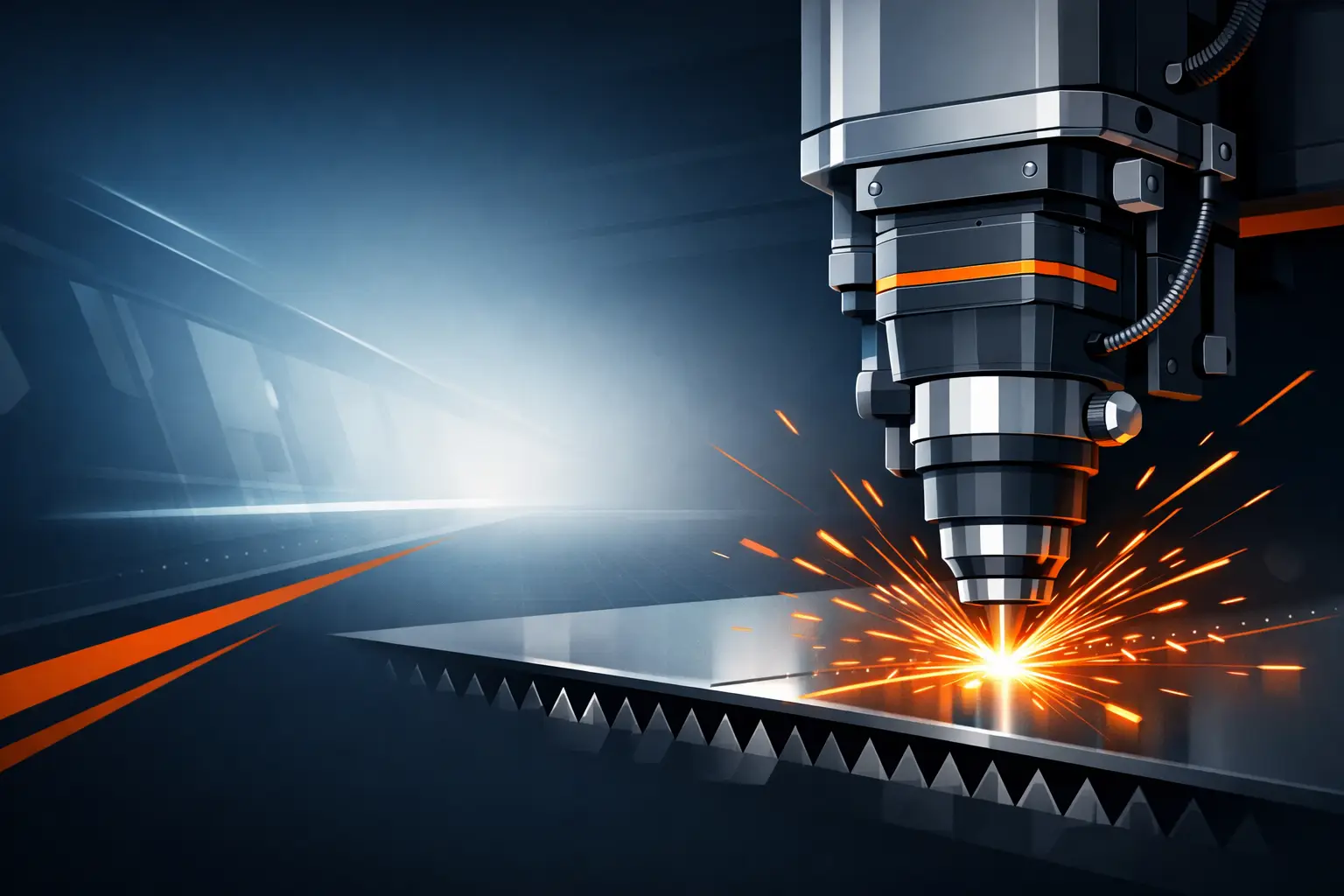
If you are comparing metal cutting equipment for production work, understanding how fiber laser cutting machine works gives you a much clearer view of where the speed, edge quality, and running efficiency actually come from. A fiber laser is not just a bright beam pointed at sheet metal. It is a coordinated system of laser generation, beam delivery, motion control, assist gas, and software, all working together to produce accurate cuts under real workshop loads.
For fabrication businesses, that matters because performance is not decided by wattage alone. The way the machine frame is built, how stable the motion system is, and how well the cutting head manages focus all affect whether a machine performs consistently over long production runs or only looks good on paper.
How fiber laser cutting machine works in simple terms
At its core, a fiber laser cutting machine creates a concentrated laser beam, sends that beam through a fiber optic delivery system, focuses it through a cutting head, and directs it onto metal. The energy density at the focal point becomes high enough to heat, melt, or vaporize a very small section of material. At the same time, assist gas blows the molten material out of the cut path, leaving a narrow kerf.
The machine does not cut by force in the way a saw, punch, or mill does. It cuts by thermal energy concentrated into a very fine spot. Because that spot is so small and controllable, a fiber laser can produce clean geometry, fine detail, and repeatable results across a wide range of metal fabrication jobs.
That is the simple version. The real value is in how each machine subsystem supports cutting accuracy, speed, and uptime.
The main parts behind the cutting process
A fiber laser cutting system starts with the laser source. This is where electrical power is converted into laser energy. In a fiber laser, the active medium is an optical fiber doped with rare-earth elements, commonly ytterbium. Pump diodes excite that fiber, which amplifies light into a high-energy laser beam suitable for cutting reflective and non-reflective metals.
From there, the beam is transmitted through a fiber optic cable rather than a mirror path. This is one reason fiber systems are efficient and relatively compact. Beam delivery is stable, alignment demands are lower than older mirror-based systems, and power losses are generally reduced.
The beam then reaches the cutting head. Inside that head, focusing optics concentrate the laser into a very small point on the material surface or slightly below it, depending on the cutting setup. The head also includes a nozzle that directs assist gas into the cut zone. Height control sensors monitor the distance between the nozzle and the sheet, helping the machine maintain a consistent standoff even if the material is not perfectly flat.
None of this works properly without motion control. Servo motors, precision guides, and a rigid machine frame move the cutting head or worktable along programmed paths. If that movement is unstable, the laser may still be powerful, but the finished part quality will suffer. That is why serious production buyers pay close attention to frame rigidity, drive components, and control system quality rather than focusing only on source wattage.
What happens when the beam hits metal
When the focused laser beam contacts the workpiece, the material absorbs energy and its temperature rises rapidly. Once enough energy is concentrated in that small area, the metal begins to melt. In some cases, part of the material may vaporize, but in most industrial sheet cutting the main action is localized melting combined with gas-assisted ejection.
The cut begins with a pierce. The machine creates an entry point by holding the beam on one spot long enough to open the material. After piercing, the head transitions into motion and follows the programmed contour. As it moves, the laser continues melting the metal while assist gas removes molten material from the kerf.
This is where control quality becomes critical. The machine has to balance power, feed rate, focal position, gas pressure, and head height. If one variable is off, you may see excess dross, rough edges, poor corners, or heat buildup. Good fiber laser performance comes from tuning the whole process, not from one component in isolation.
Why assist gas is a big part of the result
Many buyers think the laser beam does all the work. It does the heating, but the gas has a major role in cut quality and speed. Common assist gases include nitrogen, oxygen, and compressed air, depending on the material and finish requirements.
Nitrogen is often used when a clean, oxidation-free edge is needed, especially on stainless steel and parts that will be visible or welded later. Oxygen can support faster cutting in some mild steel applications because it adds an exothermic reaction, but edge condition and downstream requirements affect whether that trade-off makes sense. Compressed air can reduce operating cost for some jobs, though it may not match the finish quality or consistency needed for every production environment.
This is one of the areas where machine selection should match the work you actually run. A shop focused on decorative stainless parts will prioritize different cut settings and support equipment than a workshop processing general mild steel brackets all day.
How software and automation control the cut
A fiber laser cutting machine is only as productive as its control system and programming workflow. CAD and CAM software translate part geometry into machine paths, pierce points, lead-ins, cut order, and nesting layouts. The controller then coordinates laser output, axis movement, acceleration, and gas switching in real time.
That software layer has a direct effect on throughput. Better nesting improves material yield. Smarter pathing reduces non-cutting travel. Stable control logic helps maintain corner quality and small-hole accuracy. On busy fabrication floors, those gains are not minor. They add up quickly in labor time, sheet usage, and overall machine availability.
Automation can extend that further. Depending on the machine configuration, shops may add shuttle tables, auto-loading, extraction systems, or integrated workflow support. Those features do not change the physics of how fiber laser cutting machine works, but they strongly affect how well the machine performs in a real production setting.
What makes fiber lasers different from other cutting methods
Compared with CO2 laser systems, fiber lasers are typically more efficient for metal cutting and especially strong on thin to medium gauge materials. They are also well suited to reflective metals such as aluminum, brass, and copper, although exact performance still depends on power level, cutting head design, and process setup.
Compared with plasma, fiber laser cutting usually delivers finer detail, narrower kerf width, and cleaner edges, especially on thinner materials. Plasma still has advantages in some heavier plate applications or where lower capital cost is the main driver. Compared with waterjet, fiber lasers are generally faster for many metal sheet jobs, though waterjet remains valuable where cold cutting and no heat-affected zone are priorities.
So the right choice depends on your workload. If your shop needs high-speed sheet metal processing, precise small features, and efficient repeat production, fiber laser is often the strongest fit. If you mainly cut very thick material or have specialized edge requirements, another process may still deserve consideration.
Where machine build quality changes real-world results
This is the part many first-time buyers underestimate. Two machines can use similar source brands and still perform very differently over time. The difference often comes down to engineering discipline.
A rigid frame helps maintain accuracy during acceleration and long runs. Quality linear motion components support smoother travel and better repeatability. Clean electrical design reduces faults and makes service work more straightforward. A stable cutting head and reliable height control protect edge quality when material varies from sheet to sheet.
For production shops, support matters just as much. Installation guidance, setup assistance, spare parts access, and responsive technical help can mean the difference between a machine that earns every day and a machine that creates downtime. That workshop-first thinking is why experienced buyers look beyond headline specs and ask how the machine is built, how it is supported, and how it will hold up under actual workload.
MadBytes takes that practical view because machine performance is only proven on the floor, not in a brochure.
How to think about fiber laser capability before you buy
If you are evaluating a system, start with your materials, thickness range, production volume, and finish expectations. Then look at source power, bed size, control software, gas strategy, extraction, and loading workflow. After that, ask harder questions about frame construction, motion system quality, installation support, and long-term service.
A higher-power machine is not automatically the better investment if most of your work is light gauge and your bottleneck is loading time or software efficiency. In the same way, an entry-level machine may cut sample parts well but struggle to maintain consistency over long shifts if the frame, drives, or electrical system are not built for steady production demands.
Understanding how fiber laser cutting machine works gives you more than a technical explanation. It gives you a framework for judging machine quality, process fit, and long-term value. If the beam source, cutting head, motion platform, and support behind the machine are all working in sync, the result is what every fabrication shop wants – clean parts, predictable output, and fewer interruptions when deadlines are tight.
The smartest machine purchase is not the one with the biggest claim. It is the one built to keep cutting accurately when your schedule depends on it.